- AI video translation chains 4 steps: transcription, adaptation, rendering and human checking. A transcription error carries through to the final version.
- Subtitling keeps the original voice and image, dubbing replaces the audio track, lip sync also changes the speaker’s face.
- The voice of an identifiable person is personal data protected by the GDPR: cloning it in a new language requires a legal basis, documented by a written agreement.
- A dubbing actor has the status of performer. A version cloned into other languages may fall outside the scope of their original contract.
- Since 2 August 2026, Article 50 of the European AI regulation has required a deepfake to be disclosed at the latest at the first exposure.
- Tools announce dozens of languages, but each version needs a review by a translator who knows the target market.
AI video translation chains 4 operations: transcribing, translating, rendering the speech, then checking. Each step relies on separate tools, and an error made upstream carries through to the image. Corporate videos filmed in French can thus be released in English or Spanish without a new shoot.
The format in which the translated video is delivered then sets the level of legal exposure. Subtitling leaves the original voice and image intact. Lip sync changes the speaker’s face. The video can then become a deepfake within the meaning of the European AI regulation.
Since 2 August 2026, this regulation has required such content to be disclosed at the latest at the first exposure. The voice is also personal data protected by the GDPR. An AI video production agency combines these tools with live filming and sound work.
The 4 steps of AI video translation, from transcription to checking
An AI video translation follows the same sequence whatever tool is chosen. At each step, the machine listens, transposes and renders; a human checks. The accuracy of the transcription determines every translation that follows.
| Step | What the tool does | Point to watch |
|---|---|---|
| Transcription | Converts the audio track into time-coded text | Proper names, acronyms and technical terms misheard |
| Adaptation | Translates the text and fits it to the length of the shots | Translated text is often longer than English |
| Rendering | Produces the subtitles, the dubbed voice or the lip sync | Intonation and pronunciation of brand names |
| Checking | Review by a native translator of the target language | Figures, units and legal notices of the target country |
Adaptation hides a timing constraint. A translated text changes length, and a translation from English usually gets longer. Yet the video’s dubbing has to fit within the length of the shot. The text therefore has to be rephrased to keep a natural delivery, rather than translated word for word.
Good to know
An error at the transcription stage is expensive, because it carries through. A company head’s name that is misheard gets translated, pronounced by the synthetic voice, then matched to the lips. Correcting it means redoing the translation, the rendering and the mix of the video sequence.
To limit these corrections, some online video translation tools accept a brand glossary. HeyGen includes one in its video translator, which also accepts a translation file supplied by the user or a YouTube link. This document fixes product names, acronyms and units before the first generation. Without it, terminology may vary from one language to another.
Part of the cost then shifts to this checking: the subscription covers generation, the review remains human work.
Subtitles, dubbing or lip sync: what each format involves
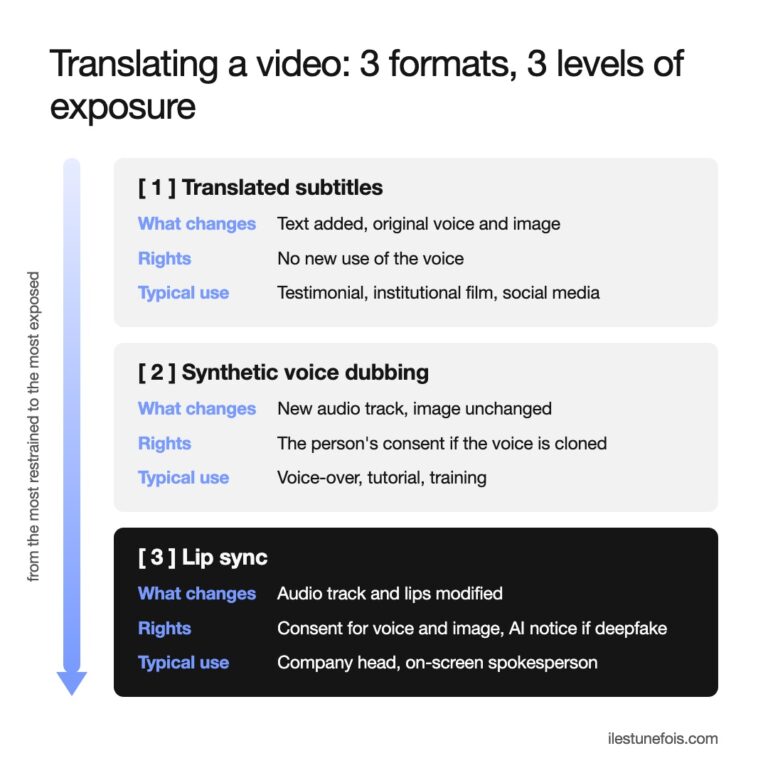
The 3 delivery formats of a translated video involve neither the same budget nor the same rights. The choice depends on the person filmed, the type of content and the target audience.
| Format | What changes | Rights involved | Typical use |
|---|---|---|---|
| Translated subtitles | Text added, original voice and image kept | No new use of the voice | Testimonial, institutional film, social media |
| Synthetic voice dubbing | New audio track, image unchanged | The person’s consent if the voice is cloned | Voice-over, tutorial, training module |
| Lip sync | Audio track and lip movements modified | Consent for the voice and the image, AI notice if deepfake | Company head speaking, on-screen spokesperson |
Subtitling, the most restrained version
Subtitling a video keeps the original voice and face. The work is about concision: a subtitle is read at the pace of speech. Subtitles also serve accessibility: on sites that are subject to it, the RGAA (the French accessibility standard) requires synchronised subtitles for pre-recorded videos, with some exceptions.
Synthetic voice dubbing and voice cloning
AI dubbing replaces the audio track without touching the image. With voice cloning, recent tools try to keep the speaker’s tone, pace and style. In October 2026, ElevenLabs announced more than 90 languages and up to 32 distinct speakers per file. This format suits videos in which the face appears little on screen. As with any AI-generated voice-over, a natural result depends above all on the script.
Lip sync, the most exposed version
Lip sync modifies the speaker’s image so that the movements of the lips match the new language. HeyGen recommends its lip-sync translation when the face is clearly visible. For a speaker who is small on screen or off camera, the publisher recommends simple audio dubbing. Sync.so presents its lip-sync engine as language-independent, from French to Spanish.
A company head who appears to speak a new language fluently can then constitute a deepfake.
Voice, image and consent: the authorisations to obtain before dubbing
Translating and dubbing a real person involves several legal regimes, from the GDPR to the European AI regulation.
The voice, a piece of personal data
The LINC, the innovation laboratory of the CNIL (the French data protection authority), points out that the voice is personal data. The GDPR protects it, and it also falls under personality rights. An employee or a company head therefore keeps rights over their voice after the shoot. Cloning it in a new language requires a legal basis within the meaning of the GDPR. A written agreement, limited in scope, keeps a record of it.
The French Criminal Code adds a penalty. Its Article 226-8 punishes the distribution without consent of generated content representing a person’s image or words. The offence does not apply if the artificial origin is obvious or disclosed. The penalties are detailed in the article on cloning a company head as an AI avatar.
The actor’s neighbouring rights
A dubbing actor has the status of performer. Article L212-3 of the French Intellectual Property Code requires their written authorisation for the recording of their performance. Its reproduction and communication to the public follow the same rule. For an audiovisual work, Article L212-4 specifies that signing the contract with the producer constitutes authorisation. This contract nevertheless sets a separate remuneration for each mode of exploitation.
Voice cloning in English or German may therefore fall outside the scope signed for the French version. The same care applies when adapting an AI advertisement for other markets.
Article 50 of the European AI regulation
Regulation (EU) 2024/1689 defines a deepfake as AI-generated or manipulated image, audio or video content. This content resembles existing people, places or events and could falsely appear to be authentic. The transparency obligations of Article 50 have applied since 2 August 2026. The deployer must disclose the artificial origin of a deepfake. This term refers to the company that uses the AI tool in a professional capacity.
The European Commission applies 3 cumulative criteria: resemblance, existence of the imitated subject and a misleading appearance of authenticity. The notice must appear at the latest at the first exposure, in visible or audible form. An invisible marking inserted by the tool is not enough. The company remains the deployer even when a service provider operates the tool on its behalf and under its control.
A neutral synthetic voice that imitates no real person is unlikely to fall within this definition. A company head dubbed through voice cloning and lip sync, on the other hand, may fall within it. The assessment takes into account the distribution context and the target audience. Fines can reach 15 million euros or 3% of worldwide annual turnover.
These authorisations are prepared before filming, by listing the target languages, media and period of use. Otherwise, adding a new language after delivery may require renegotiating with each participant.
AI video translation at Il Est Une Fois
At Il Est Une Fois, subtitle translation takes place at the file delivery stage. The master film is produced there in all the required formats. Our agency uses AI to generate these translations. Multilingual versions are among the formats we consider best suited to AI.
For voices and images, we work mainly with ElevenLabs for voice-overs and HeyGen for avatars. Lip sync, which can be tricky, goes through Sync.so. These files must then always be reworked by a sound engineer. On the agency’s corporate film projects, subtitled or multilingual versions are available on request.
FAQ: AI video translation
What is the real quality of an AI video translation?
The quality of an AI video translation depends mainly on the content to be processed. Factual, clearly spoken content without jargon usually comes through well. A slogan, a pun or precise technical vocabulary needs a translator’s revision. The machine can translate sentences; it guarantees neither the intention nor the cultural references of the target market.
Do you have to state that a video was dubbed with AI?
Yes, as soon as the dubbing or voice cloning credibly reproduces a real person. Article 50 of the European regulation then requires a clear notice, at the latest at the first exposure. In France, the Criminal Code also penalises the distribution without consent of a person’s generated words, unless the artificial origin is obvious or disclosed. For content dubbed by a neutral voice that imitates nobody, the obligation is unlikely to apply; the Commission nevertheless assesses each case according to its context.
How many languages does an AI video translation tool support?
Online video translation tools announce dozens of languages, from English to Japanese. In October 2026, ElevenLabs claimed more than 90 languages for dubbing. The HeyGen help centre lists more than 80, many of them in regional variants. The limit lies rather in checking: each new language requires a translator who knows the target market. Four checked languages are worth more than twenty translations that have never been reviewed.
How do you translate text embedded in the image?
To translate embedded text, the editor goes back to the editing project, not the exported file. Titles, cards and graphics are then regenerated cleanly in each language. Laying a translation over a flattened video means masking the old text, which may degrade the image.

Article written by David Baudry
I founded Il Est Une Fois in 2004 and I am its artistic director, personally overseeing projects with high creative stakes. Trained in film and audiovisual production, I taught at the École Supérieure des Arts Visuels in Morocco, then worked in China and the United States. Since then, the agency has produced more than 100 videos a year, including for the French Ministry of Justice, ARCEP, CNRS, the Sorbonne and UNESCO, as well as campaigns broadcast on TF1 and M6. In 2019, our work won the award for Best European Cinematography at the Grand European Off Film Awards in Warsaw.