- An AI avatar can be created in 2 ways: from a model offered by the platform, or by cloning a real person after video and audio recording.
- The library avatar is available immediately and requires no written consent: tutorial, training, internal content.
- The clone of a real person requires preparation and essential written consent: a company head’s speech, multilingual versions.
- A notice that the content is generated is recommended for a library avatar, but required by the French Criminal Code as soon as a real person is reproduced.
- Rendering quality is decided at the start of the chain: clean footage and a script written to be spoken are worth more than any output setting.
An AI avatar can be created in 2 ways: by selecting a character from a library of models, or by cloning the face and voice of a real person.
The first method raises no legal issues; the second commits you as soon as it is distributed.
At Il Est Une Fois, our audiovisual production agency knows exactly how to settle this point before any avatar is generated.
Here is how to make an AI avatar, what each method involves and what French law requires.
Making an AI avatar, step by step
An AI avatar is a video character generated and animated to give the impression that it is speaking the text you have written. It is made following the same sequence, whatever the tool:
- You select a character model, or you provide footage of the person to be cloned.
- The platform then adds a voice, chosen from a library or cloned from an existing recording.
- The system then turns your script into speech synchronised with the movement of the lips.
- The settings for framing, background and graphics come before the final export.

This sequence places quality at the start of the chain, not at the end: well-lit, well-framed, uncompressed footage gives a credible clone, whereas poor footage produces a frozen face with limited expressions. The script matters just as much as the footage, because an avatar recites exactly what is written for it, without ever rescuing a badly turned sentence.
A common belief: “creating an AI avatar takes 5 minutes.” On our projects, writing the script, testing voices and correcting the synchronisation take up most of our work before we even deliver the first version to the client. The tool has not removed the writing stage; it has only moved it ahead of the avatar’s generation.
Library avatar or clone
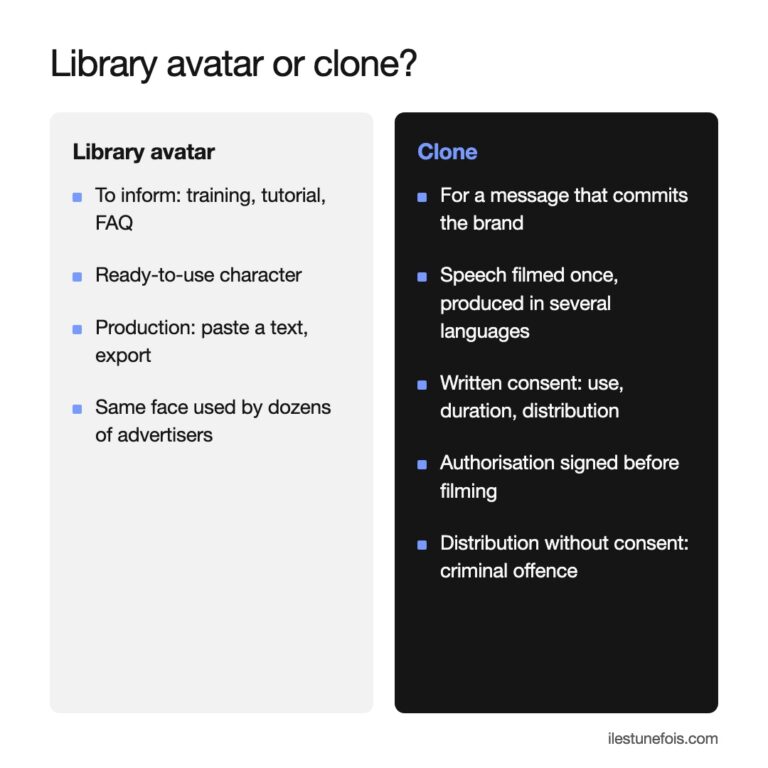
The choice between a library avatar and a clone depends on what the video has to prove. Content that informs can make do with a neutral character; a message that commits the brand requires a recognisable face.
The library avatar, ideal for getting straight to the point
The library avatar suits practical, repetitive content: training modules, product tutorials, internal notes, animated FAQs. As the character is ready to use, production comes down to pasting a text and exporting it.
Its limit lies precisely in this simplicity, because the same face is used by dozens of advertisers and is easily recognised. As soon as your communication needs to stand out, this generic character works against the message.
The company head’s clone, to embody your message
Cloning a company head, on the other hand, multiplies a speech without involving them in every shoot: a speech filmed once can then be produced in several languages, which is useful for groups with international operations, in Belgium, Switzerland or Luxembourg. This flexibility comes at a price: the cloned person must give written consent to its use, its duration and its scope of distribution.
Our key figure: we produce more than 100 videos a year, with an in-house team and high-end equipment, never through automation. The avatar replaces neither preparation nor approval.
How using an AI avatar commits you legally
Distributing an AI avatar that reproduces a real person without their consent is an offence in France.
Article 226-8 of the French Criminal Code punishes with 1 year’s imprisonment and a 15,000 euro fine the distribution of visual or audio content generated by algorithmic processing that reproduces a person’s image or words without their consent, unless its artificial origin is obvious or disclosed. The penalties rise to 2 years and 45,000 euros for online distribution.
2 reflexes therefore cover most of your brand’s protection: obtaining the written consent of the cloned person, then stating explicitly that the content was generated with AI. The rule also applies to the voice, which contracts forget to mention more often than the face. We therefore include these authorisations in the production file, in the same way as the music rights of a corporate film.
Our advice: have the authorisation signed before filming, not once the shoot is over. A company head who leaves the company 6 months later can withdraw consent for future use, and your videos then become unusable. A document that specifies the period of use, the languages and the distribution media saves you from having to redo the entire shoot.
FAQ: your questions about AI avatars
Can an AI avatar look like an existing person?
An AI avatar can only reproduce an existing person with their consent. Using the face of an employee, a company head or a public figure without authorisation exposes you to criminal proceedings. Platforms and generation tools also require proof of consent before cloning a face, and often ask for a recorded consent video.
How can you tell whether a video uses an AI avatar?
Several signs give away an AI avatar: a slight lag between the movement of the lips and the voice, a gaze that never shifts, hands that are missing or frozen, articulation that is too regular and no breathing. The mismatch is most visible on long sentences. European regulation also requires content to be identified as artificially generated.
Can you create an AI avatar for free?
Yes, several free AI avatar generators exist, with clear limits: length limited to a few minutes, watermark, restricted choice of characters and limited export. These versions, sometimes with limited image quality, are mainly suitable for an internal test or a training module. For a real clone, create an account on a verified paid offer instead.
What is the difference between an AI avatar and a deepfake?
The difference between an AI avatar and a deepfake lies in consent, not in the technology used. An avatar is based on a royalty-free model or on a person who has given informed consent, with a result that can be very realistic. A deepfake reproduces someone without their knowledge, often to deceive. French law penalises the second, not the first.
How do you create an AI avatar from a photo?
Creating a personalised AI avatar from a photo means uploading a sharp, front-facing portrait, then letting the generator animate the face with a synthetic voice. This first step is enough for a short format for social media, but the range of expressions remains limited. A few minutes of video footage always gives a much more credible and realistic clone.

Article written by David Baudry
I founded Il Est Une Fois in 2004 and I am its artistic director, personally overseeing projects with high creative stakes. Trained in film and audiovisual production, I taught at the École Supérieure des Arts Visuels in Morocco, then worked in China and the United States. Since then, the agency has produced more than 100 videos a year, including for the French Ministry of Justice, ARCEP, CNRS, the Sorbonne and UNESCO, as well as campaigns broadcast on TF1 and M6. In 2019, our work won the award for Best European Cinematography at the Grand European Off Film Awards in Warsaw.