- AI advertising mainly reduces the cost of sets, multi-format versions and complex scenes.
- It reduces neither writing time, nor art direction, nor approvals.
- Multilingual versions become affordable, which opens neighbouring French-speaking markets.
- The advertiser’s legal responsibility remains in full, whatever the degree of automation.
- A film generated without art direction is spotted immediately and weakens the brand’s credibility.
AI advertising lowers production costs on 3 specific items: sets, versions and scenes that are impossible to film.
However, it changes nothing about the initial idea, the acting or the art direction, which are among the decisive items of a film that works.
At our audiovisual production agency, we design brand films that combine live filming and set generation. Here is where this saving actually materialises, and what your responsibility as an advertiser still involves.
The 3 items where AI really reduces costs
The saving made on an AI advertisement concerns production, never creative design. 3 items account for most of the gain, precisely because they used to rely on heavy logistics:
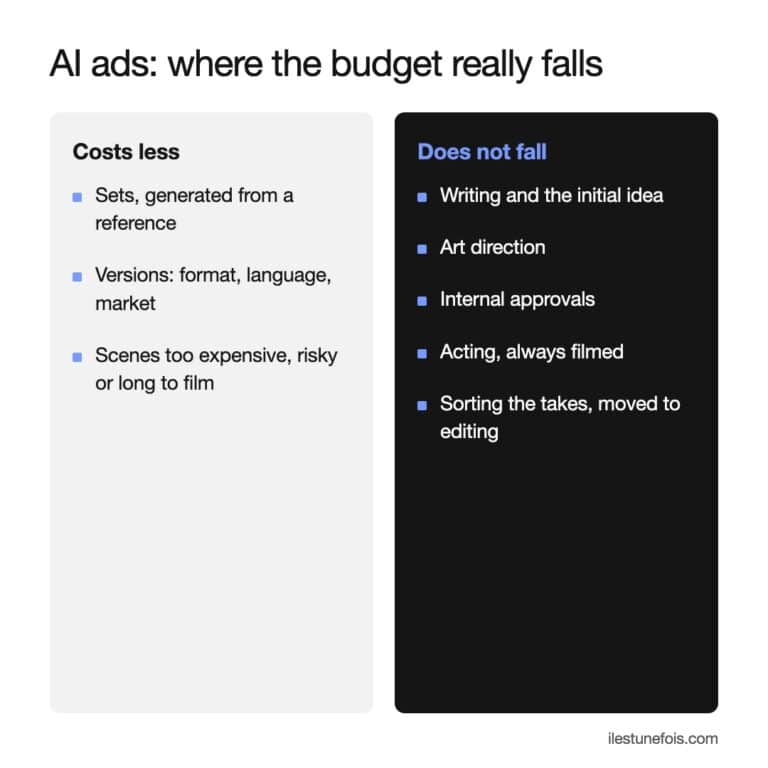
- Sets, once built, rented or scouted, are now generated from a reference visual.
- Versions by format, language and market are produced from a single master file.
- Scenes that are too expensive, too risky or too long to film become feasible without a studio set.
This last item widens the range of possibilities far more than the other 2. A sequence that a standard budget ruled out, such as a distant location or a dangerous action, can now be included in the quote without taking out insurance or scouting beforehand.
Our experience in the field: on a recent brand film, we filmed the actors’ performance in a studio and generated the entire environment around them. The client was comparing 3 quotes, 2 of which planned filming on natural locations. The hybrid approach kept to the lowest budget while preserving filmed emotion, without the viewer noticing any difference in rendering.
What AI does not reduce in an advertisement
An advertisement made with AI shortens neither writing time, nor art direction, nor internal approvals.
These 3 stages nevertheless account for most of the back-and-forth on an advertising project, and generation removes none of them: a weak idea remains a weak idea, however it is produced.
Acting is the second limit, and it is even more visible on screen. A look, a hesitation, a breath build the persuasive power of an advertising film; synthesis still renders these signals poorly over time.
We therefore film what has to move people and generate what simply has to exist in the image, a division we apply to an advertising campaign as well as to motion design graphics.
A common belief: “an AI-generated ad costs almost nothing.” This calculation leaves out artistic research, the computing power required and, above all, the time spent sorting. Getting 10 usable seconds often takes dozens of discarded attempts, and this selection is paid for in human time. The cost item therefore moves from the set to the editing room; it does not disappear.
What AI advertising does not exempt you from
Using AI changes nothing about your obligations as an advertiser. The statement of the International Chamber of Commerce (ICC), relayed by the ARPP, the French advertising self-regulatory body, points out that communication produced with AI must remain legal, decent, honest and truthful, exactly like a conventional advertisement, and that responsibility does not change with the use of the technology.
Nor does automation replace human checking. The ARPP, which developed its own model for analysing audiovisual advertisements with Google France, acknowledges that its system still produces a significant share of false positives when detecting faults. In other words, even when calibrated on decades of professional doctrine, a tool assists a decision without making it. Your legal validation and your review remain essential before distribution.
Our advice: deal with the question of notices at the brief stage, not at delivery. If your film reproduces a face, a voice or a brand, check the authorisations and the information given to the public before generation. Reworking an approved film to add a notice always costs more than planning for it.
Il Est Une Fois’s hybrid method on an advertising film
The effectiveness of an advertisement is decided in a few dozen seconds, which leaves little room for improvisation. From the writing stage, we therefore decide what will be filmed with actors and what will be generated around them, shot by shot, as on any AI video production.
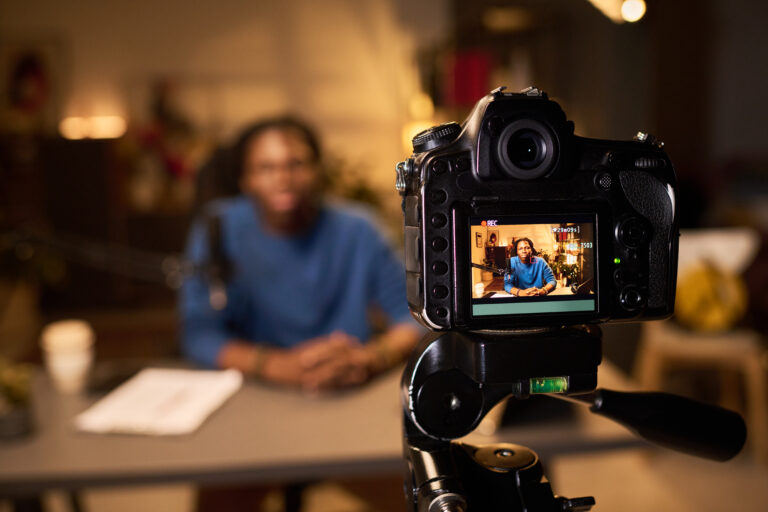
This hybrid method gives you 4 guarantees:
- Filming uses our own technical resources and our teams, without subcontracting the direction.
- Each choice between a real and a generated scene is explained, so that you can defend it to your management.
- Continuity is handled in editing, where a break in style is immediately noticeable on release.
- Your versions for neighbouring French-speaking markets reuse the same chain, without having to rebuild the film.
Do you need to present an AI advertising campaign to your management without it looking automated? Entrust the direction of your film to Il Est Une Fois: we film everything that is meant to move people and generate the rest.
FAQ: AI advertising
How do you create an advertisement with AI?
To create an advertisement with AI, start by writing the message and the script, then decide shot by shot what will be filmed and what will be generated. An image generator then works on the sets, another tool on the voice, a third on the versions. The quality of the final content depends on this division, decided before the first generation.
Is AI allowed in advertising?
Yes, AI is allowed in advertising, as long as the advertising content follows the same rules as any commercial or marketing communication. The obligations of fairness, substantiation of claims and respect for image rights apply in full to all advertising campaigns, including the processing of personal data. Reproducing a real person without their consent remains prohibited, even through a generative process.
Do you have to state that an advertisement was generated with AI?
Stating that a video advertisement was generated with AI becomes necessary as soon as the content could mislead the public, especially when it reproduces a real person, product or situation. European regulation requires clear information in these cases. If you create a purely fictional set, the notice is more a matter of the brand’s editorial choice.
What budget should you plan for an AI advertisement?
The budget for AI advertisements depends on the level of visual ambition, the number of videos to adapt and the share of filming retained. The generation item weighs less than design and editing, even when several specialised tools are used. Always ask for a quote detailed by stage, rather than a global package that hides the human time actually involved.
Can AI adapt an advertisement into several languages?
Yes, AI makes it much easier to adapt an advertisement into several languages through dubbing, subtitling and lip sync, which simplifies running the same ad across several campaigns, especially on Meta. This opens the Belgian, Swiss and Luxembourg markets without reshooting the film. A review by a native speaker remains essential, because errors often concern brand names and slogans.
Sources:
- ARPP, ICC statement on the use of AI in advertising and commercial communications (in French)
- The ARPP blog, AI and advertising: when reality catches up with the promises (in French)

Article written by David Baudry
I founded Il Est Une Fois in 2004 and I am its artistic director, personally overseeing projects with high creative stakes. Trained in film and audiovisual production, I taught at the École Supérieure des Arts Visuels in Morocco, then worked in China and the United States. Since then, the agency has produced more than 100 videos a year, including for the French Ministry of Justice, ARCEP, CNRS, the Sorbonne and UNESCO, as well as campaigns broadcast on TF1 and M6. In 2019, our work won the award for Best European Cinematography at the Grand European Off Film Awards in Warsaw.