- An AI video software never covers every stage of producing a film: it is limited to a single production task (image, voice, editing or subtitling).
- AI video software falls into 4 families: image generation, voices and avatars, editing assistance, localisation.
- Chaining several tools requires matching work that is often missing from quotes.
- Sorting the generated takes takes longer than generating them.
- The right tool is chosen according to the stage to improve, never according to the number of features available.
AI video software generally covers only one production stage, never the film as a whole: image generation, voice, editing and subtitling each fall to a separate tool, specialised in its task.
Producing a video therefore means knowing how to connect these tools to one another: it is this alignment, not the generation itself, that is the real difficulty of the project.
At Il Est Une Fois, our audiovisual production agency with over 25 years of experience, connects these different tools with an in-house team. Here is how this software breaks down and which one serves your project.
What AI video software really covers
AI video software generally applies a trained model to a single production stage, never to the others: producing an image, a voice, an edit or a subtitle. The term therefore covers products whose promises overlap little, and 4 families are enough to tell them apart:
- Shot generation from a text or an image is used to build a set or a sequence.
- Speech synthesis produces a voice, which avatar animation then pairs with a presenter.
- Editing assistance logs, subtitles and reframes the available raw material automatically.
- Localisation translates, dubs and adapts the same film into other languages and formats.
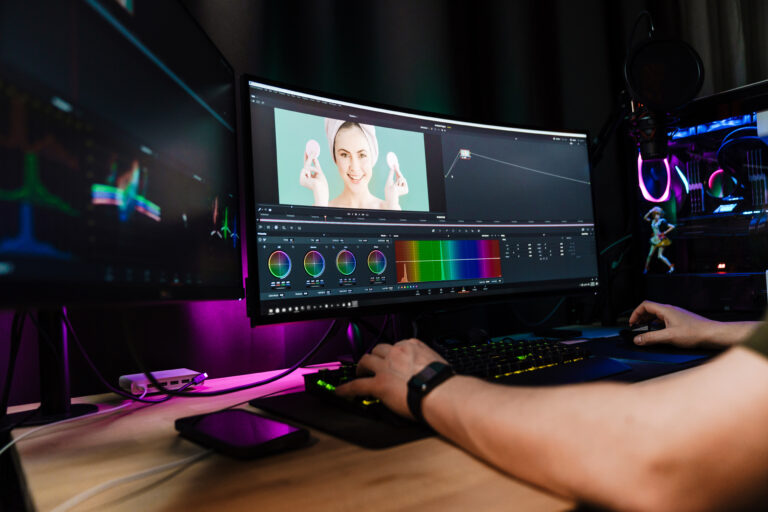
None of these 4 families of AI video software delivers a complete film, which explains a common misunderstanding among advertisers: each piece of software solves one problem, never the whole problem. It is their combination, not any one of them in isolation, that produces a video ready for release.
Our experience behind the scenes: time shifts, it does not disappear. Generating a sequence takes little time; sorting the takes, discarding unstable shots and matching what remains takes up the rest of the day. Our editors now spend more time sorting than generating, just as with conventional rushes from a shoot.
Is a single AI video software enough to produce a film?
No, using a single AI video software is not enough to produce a finished film. The tool provides raw material that is consistent over a few seconds, whereas a film requires continuity of style, light and tone over several minutes. This continuity is built in editing, never at the moment of generation.
Use is nevertheless growing in companies. According to the France Num barometer published by the French Directorate General for Enterprise, 26% of French very small, small and medium-sized businesses use an artificial intelligence solution, a proportion that doubled in one year across a panel of 11,021 companies.
The gap is therefore widening between companies that test an isolated tool and those that know how to combine several, since each tool imposes its own export format, its maximum duration and its output resolution.
Our expert view: “In the studio, an actor holds a cushion like a newborn; on screen, the scene becomes a doctor’s surgery generated by AI. We film the emotion, we generate the set: the film does not look like AI, but it has an AI budget.” David Baudry, founder and art director of Il Est Une Fois.
Choosing the right software for the stage you want to improve
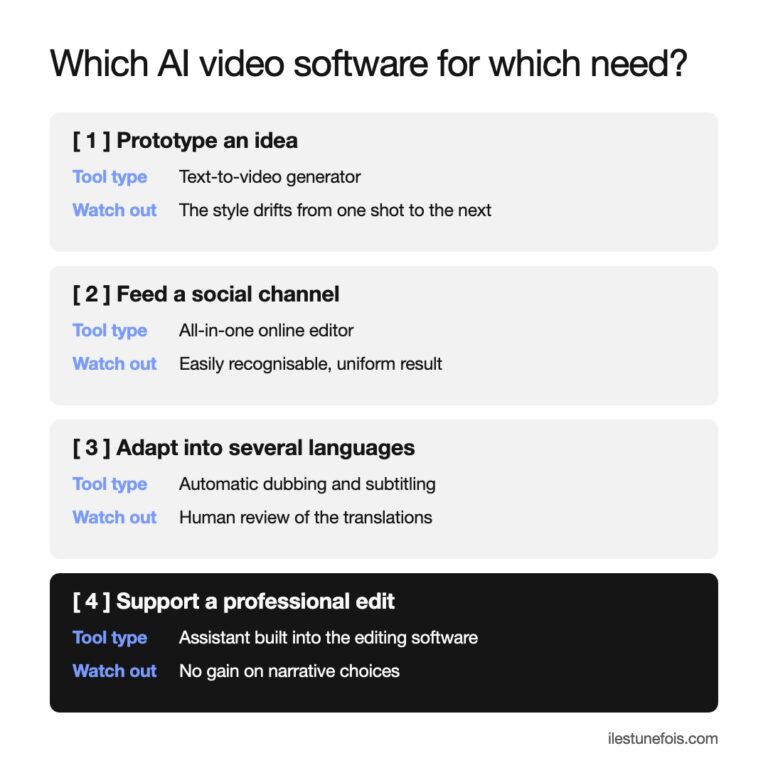
Once you understand how the different AI tools fit together, the choice depends on the stage you want to improve, not on the number of advertised features. Adapting a campaign into 4 languages and prototyping a concept do not call on the same families of AI video software. Here are the most useful matches:
| Main need | Software family | Point to watch |
|---|---|---|
| Prototyping an idea before approval | Text-to-video generator | The style drifts from one shot to the next |
| Feeding a regular social channel | All-in-one online editor | Easily recognisable, uniform result |
| Adapting a film into several languages | Automatic dubbing and subtitling | Human review of the translations |
| Supporting a professional edit | Assistant built into the editing software | No gain on narrative choices |
| Adding graphics or animating data | Motion design tools | Consistency with the brand guidelines |
We apply this division to our own productions, reserving image generation for sets and filming for the actors’ performance. This division lowers production costs without compromising on the quality of the result that your management will have to stand behind. On short formats, it feeds videos for social media without any break in style from one shot to the next.
Our advice: identify the stage that costs you the most time, then look for the software that handles it. A tool chosen for its reputation ends up unused, because it does not address a real point of friction. And if the blocking stage concerns narrative or art direction, no software will unblock it.
How we combine these tools at Il Est Une Fois
Selecting AI video software says nothing about how to integrate it into a real film. We therefore start from the expected deliverable, then work back up the chain step by step to decide what will be generated and what will be filmed.
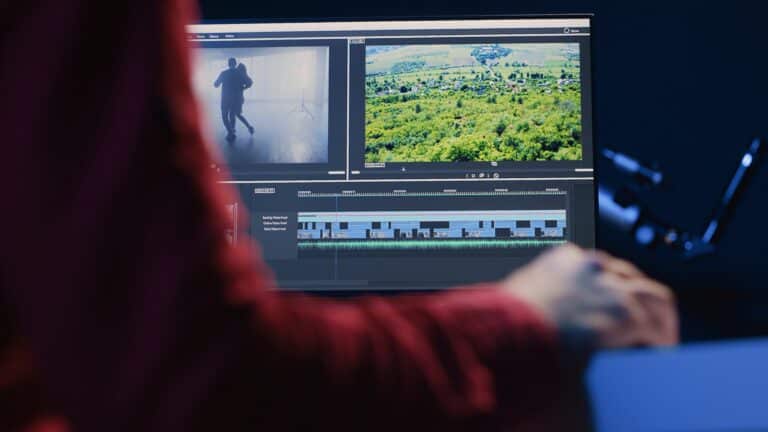
This organisation changes 4 things for you in practice:
- You no longer manage several service providers or several subscriptions, since a single point of contact follows your project from brief to delivery.
- Our teams work in-house, with high-end equipment and without subcontracting the direction.
- Each version of the video remains available in your client area, which avoids scattering files across several channels.
- The tools we choose have first been tested on our own productions, from institutional films to social formats.
The details of what an AI video generator does, and what it does not do, usefully complete this overview.
Are you comparing several quotes and want to know which AI video tools and software really lie behind each sales promise? Entrust your project to Il Est Une Fois: we manage the whole technical chain for you, from brief to delivery.
FAQ: AI video software
Which AI video software should you choose to get started?
To get started, choose an online AI video software that covers automatic editing and subtitling, rather than an image generator. These editors are easy to learn and give a usable result on short formats. You will then be able to measure the real benefit before investing in a complete chain of tools.
Is there AI video software in French?
Yes, several AI video software products offer a French interface and handle the language correctly for subtitling as well as for synthetic voices. The gaps concern the pronunciation of brands and technical terms. Listening before release is enough to avoid misinterpretations in institutional content.
What is the best free AI video software?
No free AI video software covers the whole production chain. Free offers handle subtitling and automatic editing well, image generation much less so. Almost all of them impose a limited duration, a watermark and restricted commercial use. Check this last point before publishing on behalf of a brand.
Can ChatGPT edit videos?
ChatGPT does not edit videos: it writes scripts, proposes a running order and generates shots, but it does not assemble a timeline and handles neither sound nor colour grading. Editing requires dedicated software. Many productions therefore combine the 2 tools, one to prepare, the other to produce.
Do files uploaded to AI video software remain confidential?
Files uploaded to AI video software remain confidential only if the terms of use say so explicitly. Several publishers of AI video software reuse uploaded content to train their models. For an institutional film or a sensitive subject, ask your service provider to specify where your images and voices go.
Sources:
- French Directorate General for Enterprise, France Num barometer on the digital transformation of small businesses (in French)
- CNC, Mapping of AI uses in the film, audiovisual and video game sectors (in French)

Article written by David Baudry
I founded Il Est Une Fois in 2004 and I am its artistic director, personally overseeing projects with high creative stakes. Trained in film and audiovisual production, I taught at the École Supérieure des Arts Visuels in Morocco, then worked in China and the United States. Since then, the agency has produced more than 100 videos a year, including for the French Ministry of Justice, ARCEP, CNRS, the Sorbonne and UNESCO, as well as campaigns broadcast on TF1 and M6. In 2019, our work won the award for Best European Cinematography at the Grand European Off Film Awards in Warsaw.