- An AI that turns a photo into a video generates movement from a still image to create a short animated shot.
- Generated videos last a few seconds and often require several attempts.
- The quality of the result depends largely on the source photo: sharpness, framing and resolution.
- Faces and hands remain among the most difficult elements to animate correctly.
- Integrated into a real edit, animating a photo enriches video content without replacing the work of directing.
An AI that turns a photo into a video adds movement to a still image: a gentle tracking shot, a parallax effect, the animation of a detail or a face.
To do this, the technology generates new images from the original photo, then assembles them to create a short animated shot.
At Il Est Une Fois, our audiovisual production agency includes these tools in films while keeping a natural look.
Here is how this transformation works, what it can actually create and the conditions needed to obtain a quality video.
How does AI turn a photo into a video?
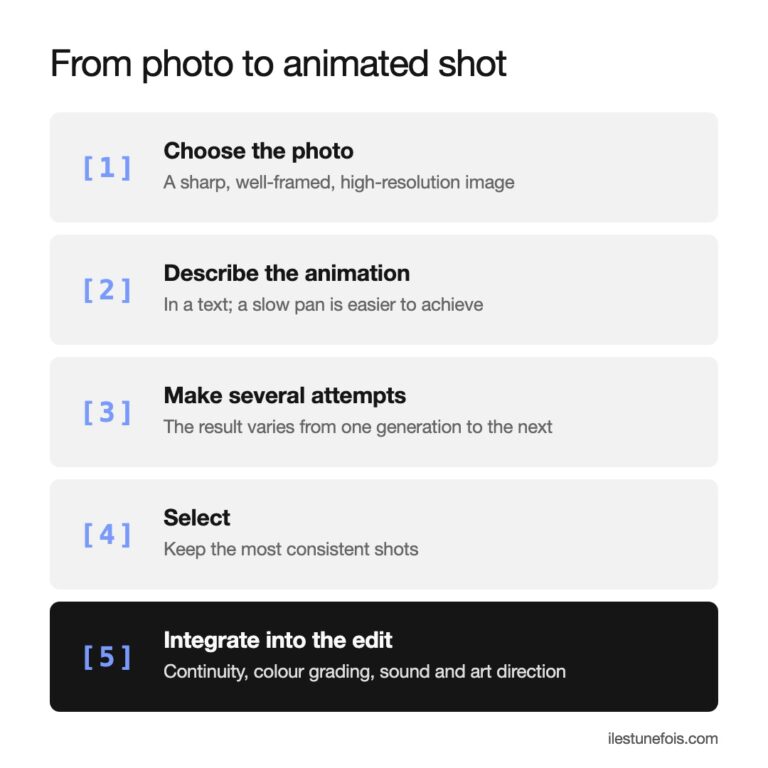
An AI turns a photo into a video by generating new images from the starting picture. From a single photo, the model anticipates a movement, recreates certain areas of the image and produces a shot lasting a few seconds. For their part, users can usually describe the animation they want in a text, then the generator offers a first video.
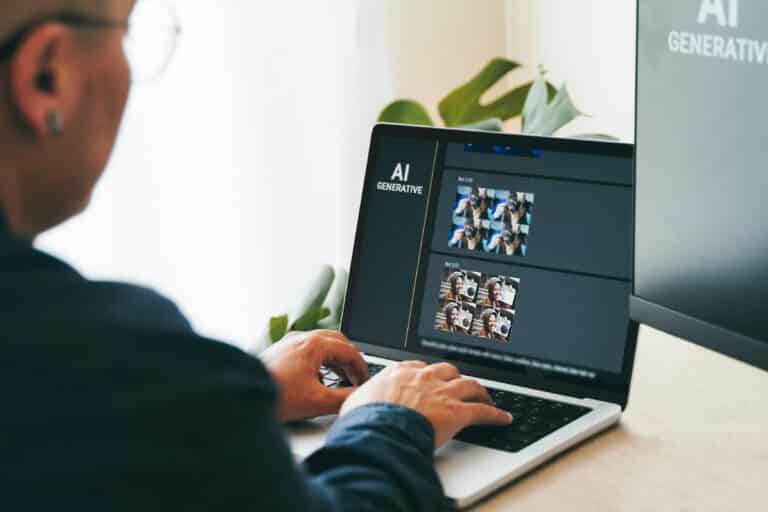
The result can vary from one attempt to the next, since the model recreates part of the scene with each generation. A slow pan or a depth effect is also generally easier to produce, whereas a precise movement requires more attempts. Creation therefore relies on several attempts, followed by a selection to keep the most consistent shots.
A common belief: “Animating a photo with AI is a gimmick.” In practice, these shots can be included in real productions alongside filmed footage and motion design. As with photo retouching, the value of the tool depends above all on how it is used and integrated into the film.
What AI photo animation can do, and its limits
An AI-animated photo can be used in several types of content, in particular short formats and videos for social media.
It can bring archives to life, animate a portrait or create a video hook from a brand visual. These formats fit particularly well into videos for social media, where a few seconds of animation can be enough to give the content more energy.
Some limits must nevertheless be taken into account. Generated clips remain short, faces can show distortions and text in an image can become harder to read.
Our advice: pay particular attention to the quality of the starting photo. A sharp, well-framed, high-resolution image produces a more stable animation. Conversely, a blurred or heavily compressed photo can lead to distortions or unnatural movements in the generated video. Choosing the source image carefully therefore limits unnecessary attempts.
How do you turn a photo into an AI video with a professional result?
A professional result rarely comes from a single image generation. It requires selecting the best attempts, matching them properly to the rest of the film and keeping the colour grading consistent.
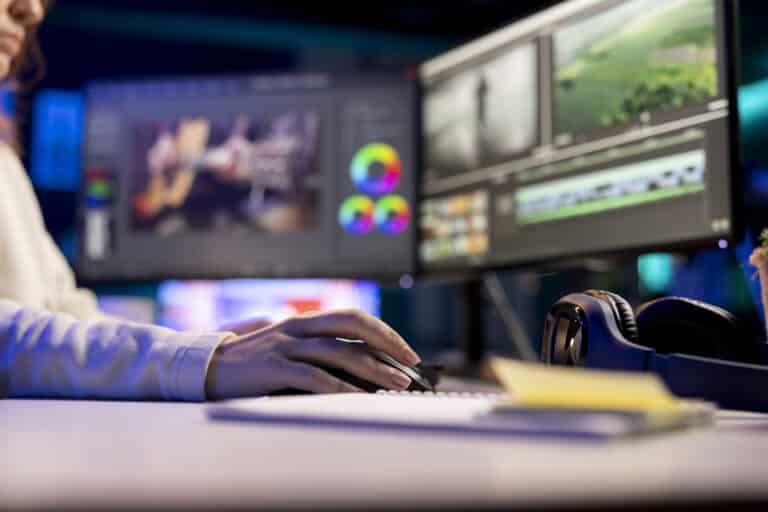
At Il Est Une Fois, we are fully aware of this and we treat these shots like the other images of a production: they are included in the edit, the sound work and the art direction.
The same standard applies to a more complete AI video production, in which the animation of a photo is only one element of the film. The aim is to keep visual continuity between real shots and generated images. When it is well controlled, this method brings AI into the content without creating an unnecessary visual break.
Our expert view: “AI is now a production tool in its own right, as photo retouching is. Its value lies in enriching the film and making it easier to produce, while keeping a natural and consistent result for the viewer.” David Baudry, founder, director and art director of Il Est Une Fois.
Do you have brand photos that you would like to turn, with AI, into videos consistent with your brand world? Entrust them to Il Est Une Fois: we animate your images and include them in a structured film, with a single point of contact from the start to the end of the project.
FAQ: turning a photo into a video with AI
Which AI turns a photo into a video for free?
Several online generators can turn a photo into a video for free with AI, with some limits: short length, watermark or variable quality. These versions can be suitable for a test. For professional use, a controlled result generally requires suitable tools and editing work on the generated videos.
How long is a video created from a photo?
A video created from a photo with AI generally lasts a few seconds. To obtain a longer sequence, several animated shots can be assembled in the edit. This short format is particularly suitable for social content, hooks and transitions.
Is the quality of an AI-animated photo good enough for a brand?
Yes, an AI-animated photo can reach a level of quality suitable for a brand, provided that the right renders are selected and properly integrated into the edit. Generated shots often need adjustments before they are used. Included in a consistent film, they can then usefully complement filmed footage.
Can you animate an old family photo with AI?
Yes, an AI can animate an old family photo from a sufficiently sharp scan. The technology can generate slight movements of the face or the background. The result nevertheless remains an interpretation created from the original image and does not exactly reproduce the scene as it happened.
Sources:
- INSEE, Intelligence artificielle dans les entreprises (in French)
- CNC, Quel impact de l’IA sur les filières du cinéma, de l’audiovisuel et du jeu vidéo (in French)
Article written by David Baudry
I founded Il Est Une Fois in 2004 and I am its artistic director, personally overseeing projects with high creative stakes. Trained in film and audiovisual production, I taught at the École Supérieure des Arts Visuels in Morocco, then worked in China and the United States. Since then, the agency has produced more than 100 videos a year, including for the French Ministry of Justice, ARCEP, CNRS, the Sorbonne and UNESCO, as well as campaigns broadcast on TF1 and M6. In 2019, our work won the award for Best European Cinematography at the Grand European Off Film Awards in Warsaw.