- Creating a video with AI follows a precise process: brief, script, storyboard, generation, editing.
- Consumer tools produce results easily, but the rendering often gives away its artificial origin.
- The hybrid method combines professional filming in real conditions with generated images to obtain a credible film.
- The cost of the project depends on the level of quality sought, the number of revisions and the time spent on artistic research.
- Working with professional support ensures the film’s consistency, the clarity of the message and respect for image rights.
Creating a video with AI goes far beyond typing a sentence into a generator. A professional, credible film starts with a brief, a script and art direction; artificial intelligence then comes in to generate certain shots that are difficult, expensive or impossible to film, such as specific sets, complex scenes or illustrative sequences.
At Il Est Une Fois, our audiovisual production studio works with a hybrid method: we film the scenes where human presence and real interactions are essential, then we generate the rest.
Here are the steps to follow, the skills to develop and the situations in which working with an audiovisual production agency adds real value.
Creating a video with AI, step by step
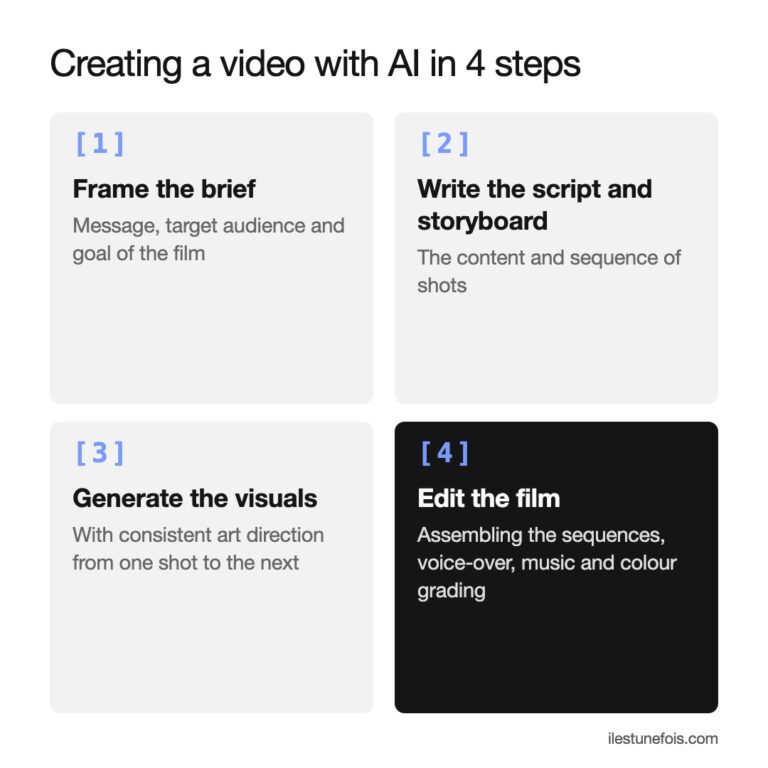
Creating a video with AI follows a precise process, close to that of a conventional audiovisual production. The brief, the script, the storyboard and the editing remain essential. Artificial intelligence then comes in to support certain production stages. A project therefore goes through the following steps:
- Framing the brief: message, target audience and goal of the film;
- Writing the script and storyboard to define the content and the sequence of shots;
- Generating the visuals while keeping consistent art direction;
- Assembling the sequences in editing with voice-over, music and colour grading.
A good prompt is therefore not enough to obtain a finished film. The generated visual content still has to be structured, corrected and harmonised to ensure a consistent result.
Our experience in the field: at first, people think that generating a video with AI is very simple. In practice, it is far more demanding, because characters and sets have to stay consistent from one shot to the next. This rigour, invisible on screen, makes all the difference between an amateur film and a film of professional quality.
Do you need technical skills to create an AI video?
Not necessarily for a test, but yes to obtain a professional result.
Creating a quality AI video requires skills in writing, art direction and editing, which go beyond simply mastering a generator.
This is reflected in studies of how AI is used in the audiovisual sector. The CNC, the French national centre for cinema, has studied its impact on film and audiovisual professions, where human expertise remains central despite automation. AI makes it possible, for example, to create scenes that are too risky or too expensive to film for real, but it never replaces scriptwriting, directing choices or art direction.
A common belief: “an AI video always looks like AI.” On the contrary, it is possible to produce a film generated by artificial intelligence that the viewer does not detect. It is ambitious and takes work, but current technologies allow it, just as special effects now blend into films without ever being seen.
In-house AI video or agency: how to choose?
The choice between an “in-house” AI video and using an agency depends on what is at stake in the film.
For a simple internal test, an online tool is enough. For a brand message, working with an AI video production agency ensures the quality of the result, faithfulness to the message and respect for image rights.
Calling on a specialist agency becomes particularly relevant when the project requires a consistent result and several approval stages. You can then rely on skills that are already mastered, without having to bring the production tools and methods in-house. For a corporate film, it also makes the project easier to follow, with a single point of contact and supervised production.
Our expert view: “The aim is to produce a film credible enough for the viewer to focus on the message, not on how the images were made. The craft remains the same, even if some sequences can now be generated with AI.” David Baudry, founder, director and art director of Il Est Une Fois.
Do you need to deliver a film to your management and are you hesitating to create a video with AI? Let’s talk about your project: we turn your idea into a credible, professional video, using a clear method that has proven itself.
FAQ: creating a video with AI
Can you create a video with AI for free?
Yes, you can create a video with AI for free for tests, in particular with some online generators. These free versions have limits, however, such as a watermark, a reduced length or uneven rendering quality. To produce a professional film that showcases a brand, you need to plan a production budget, human time and computing resources.
What does the time needed to create a video with AI depend on?
The time needed to create a video with AI depends on the complexity of the project. Image generation is only one stage: design, approvals and editing take up most of the work.
Is an AI-generated video royalty-free?
No, an AI-generated video is not automatically royalty-free. People’s image rights, notices relating to avatars and the tools’ terms of use must be checked. When AI reproduces a person’s face or voice, their consent must be clearly established to avoid any unauthorised use.
What is the difference between an AI video and a traditional video?
The main difference between an AI video and a traditional video lies in how the images are produced. A traditional video relies on images filmed in real conditions, whereas an AI video generates all or part of the sequences. The hybrid method combines these two approaches. In every case, the brief, the script and the art direction remain essential to obtain a consistent, credible film.
Sources:
- INSEE, Artificial intelligence in companies (in French)
- CNC, AI: uses and impact in film and audiovisual professions (in French)
Article written by David Baudry
I founded Il Est Une Fois in 2004 and I am its artistic director, personally overseeing projects with high creative stakes. Trained in film and audiovisual production, I taught at the École Supérieure des Arts Visuels in Morocco, then worked in China and the United States. Since then, the agency has produced more than 100 videos a year, including for the French Ministry of Justice, ARCEP, CNRS, the Sorbonne and UNESCO, as well as campaigns broadcast on TF1 and M6. In 2019, our work won the award for Best European Cinematography at the Grand European Off Film Awards in Warsaw.