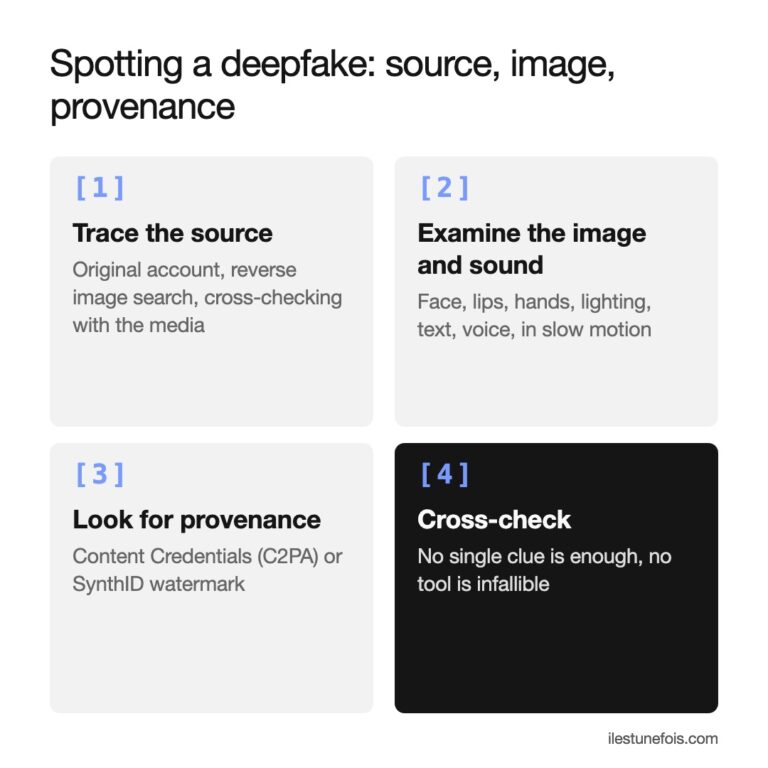
- Spotting a deepfake video relies on three cross-checks: the source of the footage, flaws in the image and sound, then provenance markers.
- Visual clues are becoming less reliable: the hairline, gaze, lip sync, hands and shadows are mainly spotted in slow motion, without absolute reliability.
- No detection tool is infallible: a detector score remains a probability, and SynthID or Content Credentials only provide information when they are present.
- Since 2 August 2026, Article 50 of the European AI regulation has required professionals to disclose the deepfakes they produce. Generative systems already on the market have until 2 December 2026 to mark their content.
- In France, the Criminal Code as amended by the SREN law penalises the distribution of a non-consensual deepfake whose manipulation is neither obvious nor disclosed. The penalty is one year’s imprisonment and a 15,000 euro fine, two years and 45,000 euros online.
- When faced with a deepfake, preserving the evidence comes before reporting it to the platform, then on PHAROS or through 17Cyber, before a possible complaint.
Spotting a deepfake video relies on three cross-checks. The first traces the source of the footage. The second examines flaws in the image and sound. The third looks for provenance markers, such as an invisible watermark.
No single clue is enough to spot a deepfake, and no detection tool is infallible. Since 2 August 2026, the European regulation on artificial intelligence has also required professionals to disclose the deepfakes they produce.
For a company, the risk is real: impersonation of a company head, fraud, false information about a brand. At Il Est Une Fois, an audiovisual production agency, AI is now part of every stage of our productions.
Visual and audio clues of a deepfake video
The technology keeps improving and removes the most obvious errors. The article on the AI revolution in video (in French) presents the tools behind this development. In recent videos, however, some details remain hard to keep consistent.
The face, the gaze and the lips
Some deepfakes rely on face swapping, with one face pasted onto another person’s body. The CNIL (the French data protection authority) lists several signals: a pixelated or blurred image, eyes that move unnaturally, a distorted or poorly synchronised mouth.
Some clues have aged badly: infrequent blinking, long cited, is no longer reliable. Deepfake creators have learned to reproduce it. Eye movements, facial expressions and the hairline can still give away a fake, without certainty.
Hands, lighting, setting and text
Beyond faces, inconsistencies can hide in the details or in the logic of the scene. According to the Luxembourg independent audiovisual authority (ALIA), AI imitates voices and gestures but has difficulty understanding physics and causality.
| Area observed | Possible clue | Limit of the clue |
|---|---|---|
| Outline of the face | Blurring or flickering along the hairline | May be smoothed out by social media compression |
| Gaze | Unnatural eye movements, fixed stare | Infrequent blinking is no longer a reliable signal |
| Mouth and voice | Lips ahead of or behind the sound | Less visible on a phone screen |
| Hands and objects | Fingers sometimes distorted, an object that changes shape from one frame to the next | Not applicable if the hands stay out of frame |
| Lighting | Shadows or lighting on the face inconsistent with the scene | Hard to judge in a close-up |
| Text in the image | A sign or badge sometimes illegible on a freeze frame | Proves nothing on its own |
According to ALIA, reliable clues are becoming rarer: detection often requires examining the footage in slow motion and frame by frame, without absolute reliability. At normal playback, a short, compressed shot can hide many of these flaws.
The voice and sound
An audio deepfake is often harder to spot, as there are no visual clues. Missing or misplaced breathing, delivery that is too regular or acoustics unrelated to the location can raise suspicion. The article on the flaws of an AI-generated voice-over describes these shortcomings in detail.

Checking the source before analysing the image
Checking the source comes before visual analysis, because it does not depend on any software. The CNIL recommends checking the source before believing or sharing content.
The first reflex is to find the original account that posted the footage. A recent profile, with no history and no one sharing its posts, may indicate a risk of manipulation. A sharp screenshot can then go through a reverse image search, which shows whether the image was already circulating.
Next comes cross-checking with the media. Important, authentic news usually leaves traces: an identified media outlet, a dated press release, the official account of the person filmed. For ALIA, a story with no trace anywhere else is probably false. An “AI-generated” label indicates synthetic content, but its absence proves nothing.
Deepfakes in companies: impersonation and phishing
Fraudsters also use deepfake technology against companies, to obtain a transfer or data. In early 2024, an Arup employee in Hong Kong transferred 200 million Hong Kong dollars, more than 25 million US dollars. He believed he was in a video call with the group’s chief financial officer and colleagues, all of them digitally recreated.
The same method drives voice phishing, where a cloned voice of a company head can back up an urgent request. Faced with an unusual transfer request, Cybermalveillance.gouv.fr (the French government’s cybercrime assistance platform) recommends verification procedures, such as calling back on a number already known. Raising employees’ awareness of cybersecurity is part of the same recommendations.
Deepfake detection tools and their limits
Detection tools provide a clue, never proof. Some analyse the image, others read an invisible mark.
Deepfake detectors
Deepfake detectors are themselves based on artificial intelligence. Their performance varies with the type of content analysed: text, image or video. Fact-checkers therefore often need to combine several tools. A high score remains a probability, not a verdict.
C2PA Content Credentials
The Coalition for Content Provenance and Authenticity (C2PA) publishes an open provenance standard. Its Content Credentials record the origin of content and the changes made to it. They can be viewed with a verification tool such as Verify. They attest to provenance, not to the truth of a scene. The C2PA also acknowledges that they can be separated from the file: their absence therefore proves nothing.
Google’s SynthID watermark
SynthID, developed by Google DeepMind, is an invisible watermark embedded in the images, videos, audio and text produced by its tools. Verification is done through the Gemini app or the SynthID Detector portal, still in a testing phase. Its scope remains limited: a negative result says nothing about a video from another generator.

Good to know
No tool settles the question on its own. A detector score remains a probability, and the absence of Content Credentials or a SynthID watermark proves nothing. Checking the source remains the first filter.
What the law requires and penalises
European law requires transparency for generated content; French law penalises its distribution without consent.
Article 50 of the European AI regulation
Regulation (EU) 2024/1689, known as the AI Act, uses the term “deepfake” for content that resembles real people or events. This content, generated or manipulated by AI, may falsely appear to be authentic. Its Article 50 has applied since 2 August 2026.
Providers of generative systems must mark their content in a machine-readable format. Professionals who use AI to produce a deepfake must disclose its artificial nature, at the latest at the first exposure. For a work that is evidently artistic, satirical or fictional, the notice is adapted so as not to hamper the work.
The omnibus regulation (EU) 2026/1744 adjusted the timetable. Generative systems placed on the market before 2 August 2026 have until 2 December 2026 to apply this marking. From that date, a ban also covers AI systems that produce realistic intimate content of an identifiable person without their consent. It applies to tools designed for this purpose or lacking sufficient safeguards.
A breach of Article 50 can lead to a fine of up to 15 million euros or 3% of worldwide annual turnover. The higher ceiling applies, except for SMEs and small mid-caps, which are subject to the lower one.
The SREN law and the French Criminal Code
In France, law no. 2024-449 of 21 May 2024, known as the SREN law (on securing and regulating the digital space), amended the Criminal Code. Article 226-8 covers the distribution of algorithmically generated content that reproduces a person without their consent. The offence also requires that the manipulation be neither obvious nor disclosed. The penalty is one year’s imprisonment and a 15,000 euro fine. It rises to two years and 45,000 euros online.
The new Article 226-8-1 targets sexual deepfakes: two years and 60,000 euros, three years and 75,000 euros online. According to the CNIL, fraud, including by deepfake, carries a penalty of five years’ imprisonment and a 375,000 euro fine. Consent on the production side is covered in the article on creating an AI avatar with the person’s consent.
Reporting deepfakes and responding
When faced with fake videos or a fake audio recording, preserving the evidence comes first. This covers the URL, screenshots, the date and the account that published it. Reporting to the platform that hosts the video follows. In France, several national services then help protect victims, individuals and companies alike:
- PHAROS, on internet-signalement.gouv.fr, receives reports of serious illegal content, including fraud.
- 17Cyber, a service of the police, the gendarmerie and Cybermalveillance.gouv.fr, guides victims.
- The 3018 helpline, free, anonymous and confidential, supports young victims of online harassment or abuse.
- A complaint is filed with the national police or a gendarmerie unit.
- The CNIL, the data protection authority, receives complaints about the use of personal data without consent.
On the company side, brand protection can also involve a factual denial, supported where possible by the authentic video.
Generated video and consent: how Il Est Une Fois works
Knowing how to spot a deepfake also informs video production. Our agency sums up its approach in one phrase: “AI video that doesn’t look like AI”. In our hybrid method, our actors perform in the studio everything that must remain human: acting, emotions, glances. AI then generates the sets, environments and locations that would be too costly to film.
When an avatar reproduces a real person, their voice and image authorisations go into the production file. They sit alongside the music rights. On our AI projects, exchanges and deliverables are centralised in a client area. The page on AI video production for companies describes each stage.
FAQ: spotting a deepfake video
How can you tell whether a video is a deepfake?
Telling whether a video is a deepfake starts with its source: the original account, coverage by the media, an official statement. Examining the face, lips, hands and shadows in slow motion comes next. A single clue proves nothing.
Is there a reliable deepfake detection tool?
No detection tool is completely reliable, and their performance varies with the content analysed. SynthID and Content Credentials provide information on provenance, but only when they are present.
Does an AI-generated video have to carry a notice?
Yes, when a professional uses AI to produce a deepfake, that is, content resembling a real person or event. Article 50 of the European AI regulation has required this since 2 August 2026.
How should you respond if a deepfake targets a company head or a brand?
In a case of impersonation, the evidence is preserved first. The content is then reported to the platform, and in France on PHAROS for serious cases. A complaint may follow.
AI video: consent in the production file
At Il Est Une Fois, when an AI avatar reproduces a real person, their voice and image authorisations go into the production file, in the same way as the music rights.
Sources:
- Deepfakes: how to protect yourself and report illegal content, CNIL (in French)
- Law no. 2024-449 of 21 May 2024 on securing and regulating the digital space, Légifrance (in French)
- Regulation (EU) 2024/1689 laying down harmonised rules on artificial intelligence, EUR-Lex
- FAQs on Content Credentials, Coalition for Content Provenance and Authenticity (C2PA)
- SynthID, Google DeepMind

Article written by David Baudry
I founded Il Est Une Fois in 2004 and I am its artistic director, personally overseeing projects with high creative stakes. Trained in film and audiovisual production, I taught at the École Supérieure des Arts Visuels in Morocco, then worked in China and the United States. Since then, the agency has produced more than 100 videos a year, including for the French Ministry of Justice, ARCEP, CNRS, the Sorbonne and UNESCO, as well as campaigns broadcast on TF1 and M6. In 2019, our work won the award for Best European Cinematography at the Grand European Off Film Awards in Warsaw.