- What determines the quality of the result: the script, its punctuation and its sentence length.
- The recurring weak point: proper names, acronyms and technical vocabulary.
- The most effective uses: tutorials, training modules and multilingual versions.
- Using an actor remains preferable for a sensitive message, an advertisement or a brand’s signature voice.
- The voice is personal data protected by the GDPR, whatever tool is used.
Why do some AI voice-overs sound natural, while others sound robotic?
The answer lies in the writing, not the tool: an AI voice-over sounds right when the text is written to be spoken, not when all you provide is a catalogue of voices.
Punctuation, sentence length and the spelling of proper names determine intonation far more than the chosen voice.
At our audiovisual production agency, we edit brand films in which the voice carries the message, whether generated or recorded. Here are the settings that make the difference, the cases where using an actor remains preferable, and what cloning a voice involves.
What makes an AI voice-over sound right
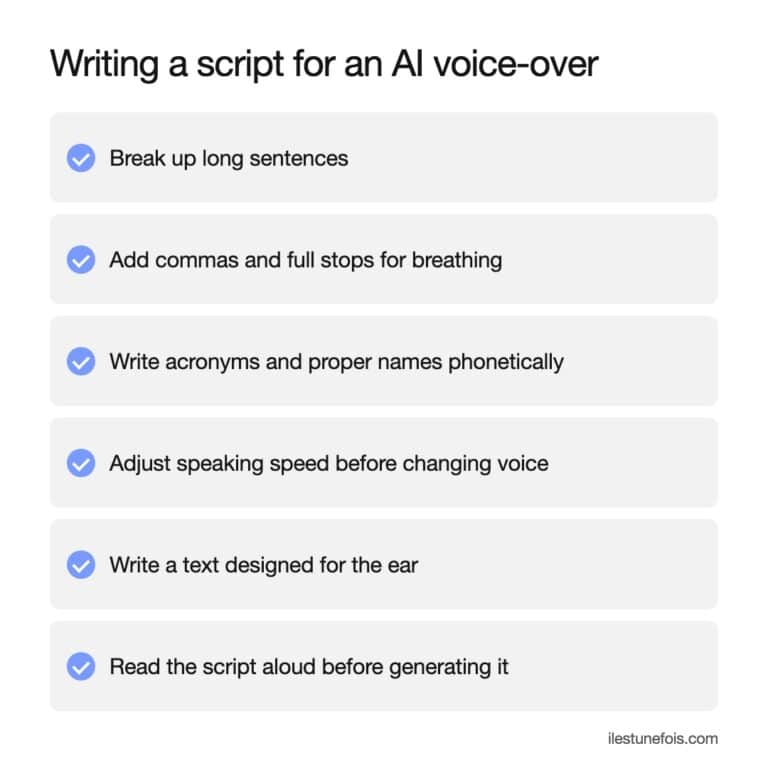
The result of an AI voice-over is decided in the writing, even before it is generated. The synthesis engine takes punctuation literally and never corrects the text it is given. 4 settings therefore matter more than simply changing the voice:
- Break up long sentences, on which speech synthesis loses its breath and its intonation.
- Punctuation directly controls the synthesis’s breathing, which is why you should add commas and full stops rather than remove them.
- Acronyms and proper names are written phonetically as soon as the pronunciation goes wrong.
- Adjusting the speaking speed affects how natural the result sounds more than the choice of voice itself.
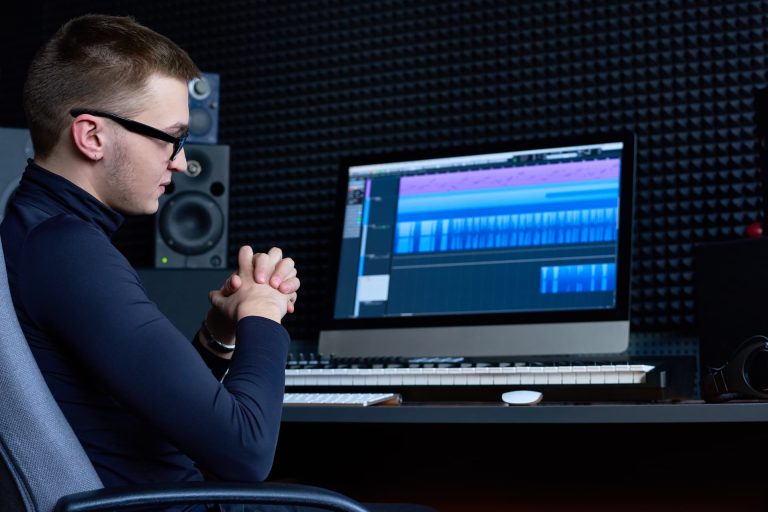
These adjustments explain the difference in quality between 2 videos produced with the same tool. A text designed for the eye also always sounds wrong to the ear, whatever the budget spent on the voice-over. Reading your script aloud before pasting it into the generator therefore remains the simplest and cheapest test.
Our experience behind the scenes: our editors almost always correct the text, very rarely the voice. A product name mispronounced, an abbreviation read letter by letter, a sentence that runs out of breath: these flaws are fixed by rewriting, not by changing model. Going back and forth between script and listening therefore takes up most of the production work on long content.
When a human voice remains preferable
A human voice is needed as soon as the message commits the brand or the viewer’s emotions. In practice, speech synthesis renders neutral information correctly, but it flattens the irony, hesitation and rising intensity that make an advertisement or a company head’s speech effective.
How often the content is updated is the second criterion. A training module revised every quarter benefits from being generated, since the text changes without having to book a new studio session.
A signature voice, the one your customers recognise from one film to the next, loses all its value by becoming interchangeable. This double criterion guides our choices on a corporate film as on short formats.
A common belief: “synthetic voices no longer fool anyone.” On a single sentence, it does go unnoticed, but after a few minutes the ear picks up the unnaturally regular delivery and the complete absence of vocal fatigue. It is the length that gives it away, not the quality of the model, and many of our choices come down to this criterion alone.
Cloning a voice: what the law governs
Cloning a voice involves much more than a technical setting, because the voice is personal data. The LINC, the digital innovation laboratory of the CNIL (the French data protection authority), points out that the voice is protected by the GDPR, while 82% of French people are unaware of this. Reproducing the voice of an employee or an actor therefore requires explicit, documented consent.
Beyond the GDPR, the subject goes further than data protection alone. The Adami, the French society that manages performers’ rights, defends 3 principles in relation to AI: transparency about the content used to train models, the performer’s consent and their remuneration. A voice actor has neighbouring rights over their performance, which many advertisers discover when they reuse an old soundtrack to clone it.
Our advice: treat the voice like music in your production file. State in writing who authorises what, for which media, in which languages and for how long. This page of contract saves you from redoing an entire campaign because a reproduced voice had no valid authorisation.
How Il Est Une Fois chooses between a generated and a recorded voice
On a series of videos, the choice of voice is almost never made for the whole set: the same advertiser often mixes generated training modules with recorded brand films. We therefore decide format by format, based on the listening time and what is at stake in the message.
Our work then takes place in 4 stages:
- We rewrite the script for the ear before any generation, to remove sentences that are too long for speech synthesis.
- Our tests use your technical vocabulary and your product names, never a generic demo.
- An actor takes over as soon as the voice commits the brand, under our direction and with our technical resources.
- Usage authorisations are settled upstream, before any adaptation for Belgium, Switzerland or Luxembourg.
Do you need to add an AI voice-over to a series of videos without taking any risks? Contact Il Est Une Fois: we decide on each format, generated or recorded, and secure the agreements upstream.
FAQ: all about AI voice-overs
How can you create an AI voice-over for free?
To create an AI voice-over for free, several online generators offer a trial, often limited to a few minutes a month, with a reduced choice of voices and no commercial use. Check this last point before any distribution, because many free licences prohibit advertising use of the file produced.
What is the best AI voice-over in French?
No AI voice-over stands out as the best in French, because quality depends on the type of content. Neutral voices suit tutorials, richer voices suit narrative content. Always test your own script with your product names, rather than the publisher’s demo.
Can you clone your own voice for your videos?
Yes, you can clone your own voice for your videos, from a few minutes of clean recording with no background noise. Platforms generally ask for a recorded proof of consent. Remember to limit the use of the resulting model by contract, especially if you ever leave the company concerned.
Is an AI voice-over suitable for a corporate video?
An AI voice-over is well suited to an informative corporate video: internal procedure, software tutorial, training module or content to be produced in several languages. For a recruitment video, a sensitive announcement or a brand campaign, a recorded voice conveys a commitment that synthesis still struggles to carry.
How can you recognise an AI-generated voice-over?
You can recognise an AI-generated voice-over by its regular delivery, the absence of fatigue over long sequences and liaisons that are sometimes wrong. Breaths fall in the wrong place and intensity varies little. These signs fade on short formats, but stand out clearly beyond 2 minutes.
Sources:
- LINC, digital innovation laboratory of the CNIL, The rights of the voice (in French)
- Adami, Performers and artificial intelligence (in French)

Article written by David Baudry
I founded Il Est Une Fois in 2004 and I am its artistic director, personally overseeing projects with high creative stakes. Trained in film and audiovisual production, I taught at the École Supérieure des Arts Visuels in Morocco, then worked in China and the United States. Since then, the agency has produced more than 100 videos a year, including for the French Ministry of Justice, ARCEP, CNRS, the Sorbonne and UNESCO, as well as campaigns broadcast on TF1 and M6. In 2019, our work won the award for Best European Cinematography at the Grand European Off Film Awards in Warsaw.