- The specification for a corporate film describes the project before any quote. It covers context, objectives, audiences, messages, form, constraints, budget, schedule, deliverables and approval.
- Ranked objectives and three or four key messages keep the story readable. Each message ideally rests on concrete evidence.
- Anyone identifiable on screen must in principle authorise the use of their image, voice and name. This authorisation specifies its duration and territory.
- Music from the Sacem repertoire requires a corporate film authorisation, valid for free-of-charge distribution. A commercial recording also requires the consent of its producers.
- The RGAA (the French digital accessibility standard) provides, where necessary, for synchronised subtitles on the videos of public bodies. Companies are concerned from an average annual turnover in France of €250 million.
- In a French public contract, the technical requirements for the film appear in the specific technical specifications, or CCTP.
The specification for a corporate film describes the video project before any quote. It answers 3 questions: why this film, for whom, and within what framework.
The document brings together the context, the objectives, the audiences and the key messages. It then sets the form of the film, its versions and its languages. Finally, it specifies the constraints, the budget, the schedule, the deliverables and the approval process. This brief opens the first stage of any corporate and institutional film production.
What the specification for a corporate film is for
A corporate film presents an organisation, its missions and its values. Its uses are described in the article on the benefits of a corporate film for a company. This document turns that intention into a clear order.
It has 3 functions. First, it aligns communications, marketing, HR and senior management. Second, it makes quotes comparable from one supplier to another. Third, it serves as the reference at each approval, from writing to the final edit.
In a French public contract, the technical part is called the cahier des clauses techniques particulières (CCTP, the specific technical specifications). The 2021 CCAG for intellectual services (the French general administrative terms for public contracts) defines it as the contractual document setting out the technical terms of performance.
The structure of a corporate film specification, section by section
A precise specification follows the order of the production stages: meaning first, then form, then framework.

Context and company presentation
This section presents the organisation’s activity, history, locations and news. Above all, it explains the trigger for the project: an anniversary, a merger, a recruitment campaign or a new positioning. Existing films and the brand guidelines complete the file.
Objectives of the film
An objective is expressed with a verb and an expected result. Attracting candidates, reassuring investors and bringing teams together call for different stories. One main intention, with one or two secondary intentions, keeps the story readable. Success indicators also belong here: views, applications received, complete viewings.
Target audience and key messages
The target audience is described precisely: employees, customers, partners, candidates or the general public. Their level of knowledge of the subject matters as much as their profile. The key messages are limited to three or four ranked ideas. Each ideally rests on evidence: a figure, a testimonial, an achievement.
Tone, style and references
The tone gives the story its colour: restrained, warm, educational or offbeat. A few links to films you like, with the reason for the choice, are worth more than a long paragraph. A counter-example also clears up many ambiguities. The choice between live action, interviews and motion design animation is discussed at this stage.
Format, length, versions and languages
The form depends on the target screens: website, trade fair, internal convention, intranet or social media. The target length is given for the main version, with the other versions listed separately: short version, teaser, vertical and square formats. The languages are specified from the outset. A foreign-language voice-over, dubbing or subtitles affect both the writing and the editing.
Filming constraints, rights and accessibility
This section lists the filming locations, their access and the likely speakers. Three legal and technical topics complete it.
Image rights. A person who can be identified on screen must in principle give their authorisation, as the APIE unit of the French Ministry of the Economy points out. The rule also applies to their voice and name. The authorisation must be precise: duration, territory, terms. Agreeing to be filmed does not mean agreeing to every use.

Music. For a corporate film, Sacem (the French collective management society for music authors) offers an authorisation issued by SDRM for its repertoire. It covers in particular free-of-charge screenings on business premises, at trade fairs and on the company’s website. Distribution on social media is not included and must be checked separately. A commercial recording also requires the consent of its producers. SDRM does not issue any authorisation without the publishers’ consent. The brief therefore specifies the music expected: original composition, library music or a well-known track.
Accessibility. The RGAA (the French digital accessibility standard) provides, where necessary, for synchronised subtitles on pre-recorded videos. It also provides for a text transcript or audio description, depending on the case. These obligations apply in particular to the online services of public bodies. They also apply to companies with annual turnover in France of €250 million or more. This threshold is calculated as an average over the last three closed financial years.
Budget, schedule and milestones
A budget envelope, even a broad one, allows agencies to propose a realistic and comparable approach. The items that make a quote vary are detailed in the guide to the price of a corporate video service. The schedule starts from the release date and works backwards. It sets the milestones: choice of supplier, approval of the script, filming, first version, final version.
Deliverables, file formats and approval process
The list of deliverables mentions the master film, the versions, the subtitle files and what happens to the rushes. The technical specifications follow the media: resolution, aspect ratio, lightweight file for the web or high quality for projection.
The approval process names a single contact and the approvers for each stage. It sets the number of rounds of revisions on the script and the edit. A decision-maker who discovers the film at the end may call into question choices that have already been approved.
Supplier selection criteria in a tender
In a tender, the document states the selection criteria and the expected content of the responses. Common criteria cover references, understanding of the brief, the statement of intent, the team and the price. The points to check are covered in the article on choosing a video production company.
For a French public buyer, the technical requirements appear in the CCTP. When the contract refers to the CCAG for intellectual services, its article 35 governs the rights to the results. For films, it provides for the delivery of the source and native files, in an open format, unless the contract states otherwise.
The summary checklist
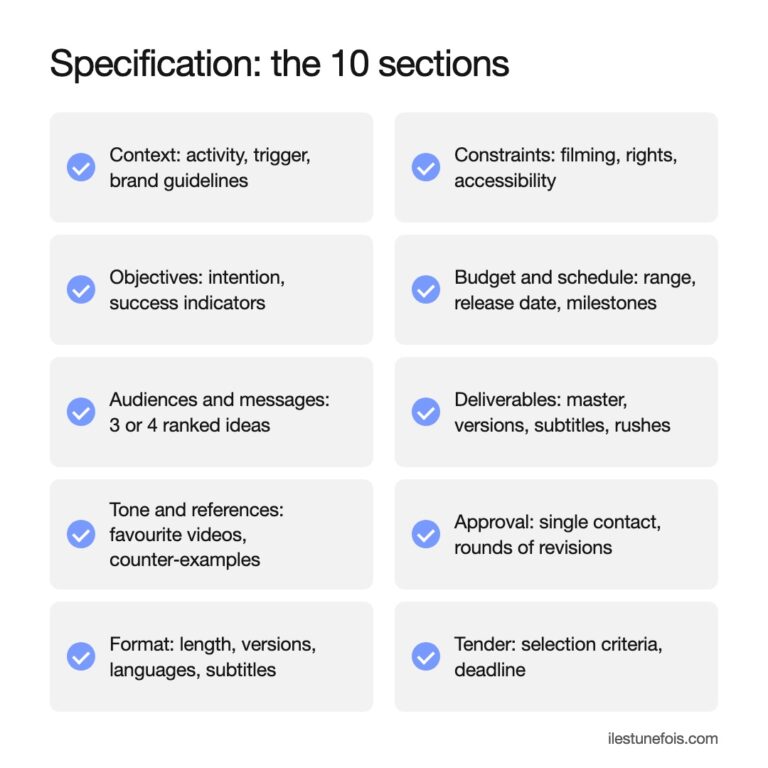
This table sets out each section and serves as a review grid before the document is sent to agencies.
| Section | Expected content |
|---|---|
| Context | Activity, trigger, brand guidelines |
| Objectives | Main intention, success indicators |
| Audiences and messages | Target profiles, three or four ranked ideas |
| Tone and references | Reference videos, counter-examples |
| Format and versions | Length, vertical and square versions, languages, subtitles |
| Constraints | Locations, speakers, image rights, music, accessibility |
| Budget and schedule | Range, release date, milestones |
| Deliverables | Master, versions, subtitles, rushes |
| Approval | Single contact, number of rounds of revisions |
| Tender | Selection criteria, deadline for responses |
Common mistakes in a video brief
Most pitfalls come from a document that is too vague or, conversely, too prescriptive.
- Targeting every audience at once: the message is diluted and loses impact.
- Piling up messages: ten ideas in two minutes leave little room for each one.
- Not stating the budget: the proposals received become difficult to compare.
- Writing the script in the agency’s place: a brief that is too prescriptive restricts the creative proposal.
- Forgetting the versions: a vertical version decided after filming sometimes forces a tight crop.
- Overlooking authorisations: a missing signature can block the distribution of a sequence.

My view as a producer
David Baudry, founder and art director of Il Est Une Fois
A good brief does not have to be long. I prefer one clear page on the objective, the audience and the messages to a file that already describes every shot. When the brief leaves room, the writing can suggest an angle nobody had thought of. And when the brief remains vague, the first conversation is there precisely to clarify it.
How Il Est Une Fois works from the client’s brief
An audiovisual production agency founded in 2004, Il Est Une Fois starts every project with a conversation and a brief. In it, we clarify the objectives, the message, the audience and the distribution constraints.
Some clients bring a final script, others a text to be reworked or a precise brief. Others have no precise brief and expect advice on their communication strategy. If needed, our team then writes a script or a running order. This design phase sets the narrative angle, the tone and the visual style, which are approved together before filming.
A reverse schedule is set at the start of the project. Filming can take place on the client’s premises. Post-production covers editing, colour grading and sound mixing. Videos are delivered in 16:9, vertical or square, with subtitled or multilingual versions on request. The agency was also selected in a public tender by the French Ministry of Justice to design and produce its WebTV.
The types of film are presented on our page on corporate film production in Paris. For an animated film, the motion design video page describes our approach.
FAQ: corporate film specification
What are the 4 components of a specification?
For a corporate film, 4 blocks structure the document: context, objectives, constraints and production framework. The context presents the company and the project. The second block specifies audiences and messages. The constraints cover locations, speakers, rights and accessibility. The framework brings together budget, schedule, deliverables and approval.
What are the two types of specification?
In practice, a distinction is made between a functional specification and a technical specification. The first expresses the need and the expected result, without imposing a solution. The second describes the means and the specifications. The brief for a corporate film is mainly functional.
What is the difference between a brief and a video specification?
The brief is the short version. It focuses on the intention, the audiences and the messages. The full version adds constraints, deliverables, schedule and approval process. In a tender, it is the full version that makes the responses comparable.
Should you give the agency a budget?
Yes, a range is enough. It allows agencies to size the filming, the post-production and the versions. Without any indication, the proposals rest on approaches that cannot be compared. This figure also avoids unnecessary back-and-forth.
A corporate film to get started?
At Il Est Une Fois, a corporate film starts with a conversation and a brief. The angle, the tone and the style are approved before filming.
Sources:
- Image rights of people and property, APIE unit, Ministry of the Economy (in French)
- Obtaining a corporate film authorisation, Sacem (in French)
- RGAA criteria and tests, Multimedia theme, DINUM (in French)
- Scope of the RGAA, DINUM (in French)
- Order of 30 March 2021 approving the CCAG for public contracts for intellectual services, Légifrance (in French)
Article written by David Baudry
I founded Il Est Une Fois in 2004 and I am its artistic director, personally overseeing projects with high creative stakes. Trained in film and audiovisual production, I taught at the École Supérieure des Arts Visuels in Morocco, then worked in China and the United States. Since then, the agency has produced more than 100 videos a year, including for the French Ministry of Justice, ARCEP, CNRS, the Sorbonne and UNESCO, as well as campaigns broadcast on TF1 and M6. In 2019, our work won the award for Best European Cinematography at the Grand European Off Film Awards in Warsaw.